
LIFE RESTART

 SWMMS 2026. LIFE RESTART opens up new perspectives for the circular economy. Crossing research

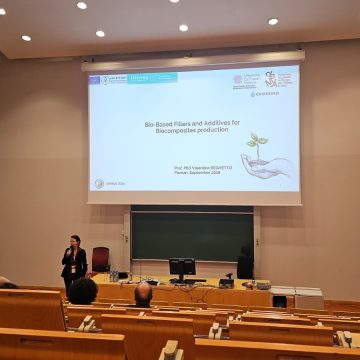
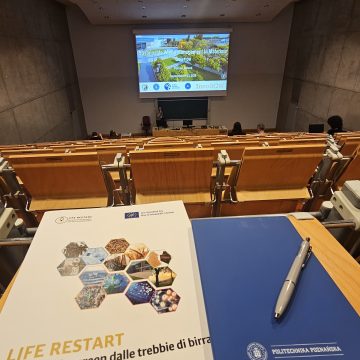
Transforming a by-product of the beer production industry into a resource for the development of new biodegradable materials. This is the objective of the study carried out by researchers from Ca’ Foscari University of Venice and Crossing Srl, focusing on the valorisation of brewer’s spent grain, one of the main by-products of beer production. The work was presented at the SWMMS 2026 Conference (Sustainable Waste Management in Material Science), held in Poznań, Poland, from 21 to 23 September 2026.
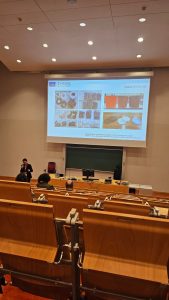 The study explored an innovative approach: using brewer’s spent grain not only as a solid component within a biocomposite, but also as a raw material from which to derive additives capable of improving the material’s performance.
The approach developed therefore represents a particularly advanced example of the circular economy: a by-product of the food industry is transformed simultaneously into a raw material and a source of additives for the production of new materials.
According to the authors — V. Beghetto and G. Foltran, Department of Molecular Sciences and Nanosystems, Ca’ Foscari University of Venice, and R. Samiolo and S. Conca, Crossing Srl, Treviso — this is the first case in which an agri-food by-product has been used within the same biocomposite both as a filler and as a source of compatibilisers.
The research therefore opens up new perspectives for the development of biodegradable materials capable of reducing the use of virgin resources and enhancing the value of by-products that are currently used mainly in low-value applications.
The study was carried out with the support of PNRR funding for the 38th cycle of the National PhD Programme in “Design for Made in Italy: Identity, Innovation and Sustainability” and within the framework of the LIFE RESTART project.
Co-funded by the European Union. Views and opinions expressed are however those of the author(s) only and do not necessarily reflect those of the European Union or CINEA. Neither the European Union nor the granting authority can be held responsible for them.