
LIFE RESTART

 Environmental Education Workshops in Partnership with the Local Community

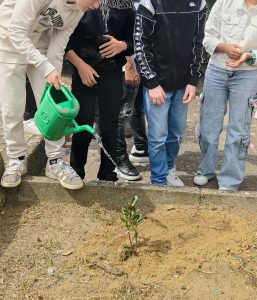 Since the launch of LIFE RESTART, Fondazione Messina has involved children and young people aged 6 to 17 in a series of educational activities at the emerging Olivettian Hub in Roccavaldina and throughout the wider area of the Metropolitan City of Messina. At the heart of the programme are hands-on workshops designed to develop STEAM skills with a focus on tackling climate change, created in collaboration with local organisations and schools.
The principles of caring for and respecting the environment have been brought to life through activities in which young participants helped look after shared community assets by taking part in widespread workshops focused on sowing seeds and planting young plants and trees. This marked the beginning of a distributed nursery at Fabbrica Zero in Roccavaldina, the heart of the initiative, which has since expanded to other regenerated spaces returned to the community, as well as to schools in the village and across the Metropolitan City.
From Planting to Music
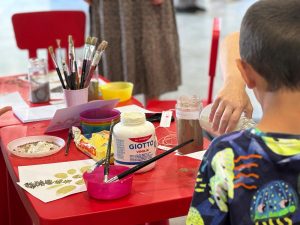 A wide range of awareness-raising activities has been developed around planting, embracing the challenge of sparking curiosity, inspiring fascination and encouraging participants to experience nature as both a co-creator and the source of a shared future.
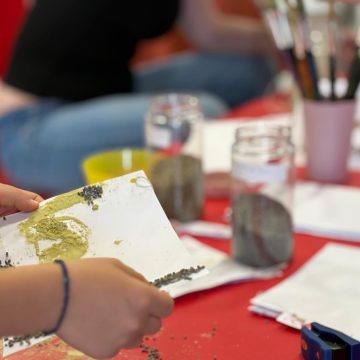
These activities have included animated readings, the discovery of traditional herbariums, the cataloguing of native plants, and experiments with natural pigments extracted directly from plants and used to create imaginative drawings. These works have, in turn, filled new “fantastical herbariums”.
Finally, each young plant or seed previously planted has been associated with a musical note. At the end of the project, all the notes will be harmoniously combined to create a highly symbolic “symphonic forest”.
The beginning of this joyful reforestation process, designed to help mitigate global warming, is fully aligned with educational practices that view nature as both an opportunity and a driving force for change that is compatible with the lives of people and the wellbeing of local communities.
This approach also includes the many visits to Fabbrica Zero by students of all ages, workshops on new biomaterials required for the ecological transition, and activities exploring how renewable energy communities operate.
Co-funded by the European Union. Views and opinions expressed are however those of the author(s) only and do not necessarily reflect those of the European Union or CINEA. Neither the European Union nor the granting authority can be held responsible for them.