
LIFE RESTART

 The Zero Factory towards the market

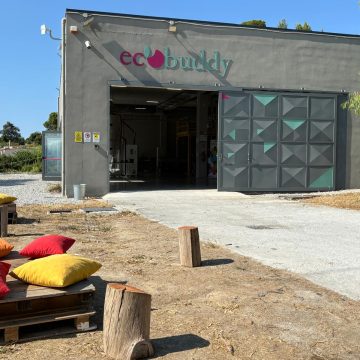
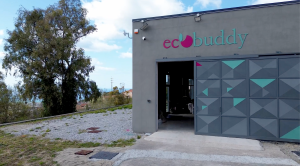 The validation of semi-industrial scale production of bioplastics derived from brewers’ spent grains was completed some time ago within the framework of LIFE RESTART. In recent months, the process has been successfully transferred to pellets produced with olive pomace and silverskin (coffee processing waste), whose characterization is being finalized by EcosMed, UNIME, and Crossing.
Samples of ecobuddy bioplastics made with spent grains, pomace, and silverskin were also sent to a leading Total Quality Assurance company and proved suitable for certification, specifically for the production of toys. This has helped renew relationships with companies in the sector, which are now preparing to carry out their own printing tests on their products.
The certification suitability process for materials intended for the production of plant pots will also be launched, in view of the first market orders.
 In recent months, an agreement was also signed with an important agency for the promotion and distribution of ecobuddy biocompounds in central and southern Italy, with a particular focus on the packaging sector and accessories for the home and personal use.
Plant Pots: The First Prototypes
Meanwhile, Giardineria Italiana has continued its work with encouraging results. The development of plant pots made of bioplastic from spent beer grains and olive pomace has led to the delivery of the first prototypes. The samples passed the first evaluations. Externally identical to traditional polypropylene (PP) pots, they stand out for their remarkable lightness without compromising sturdiness.
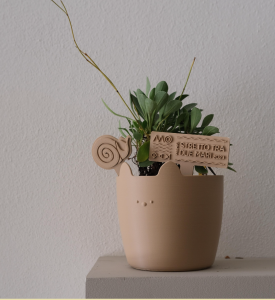 The only sensory detail is the smell of the raw material, which recalls the natural origin of the compound and marks a clear difference from plastic.
This step forward paves the way for the crucial phase of agronomic experimentation. The final pots will be integrated into a trial phase to be tested under real operating conditions during the cultivation of ornamental plants. They will be used to cultivate various species, depending on needs, exactly as with fossil-based polypropylene (PP) pots and with different substrates.
The goal? To monitor their performance over time: resistance to handling, exposure to weather conditions, and their natural process of deterioration/biodegradability. This field validation is essential to confirm the product’s sustainability and close the loop of the circular economy, transforming an industrial by-product into a resource for horticulture.
The Research Continues
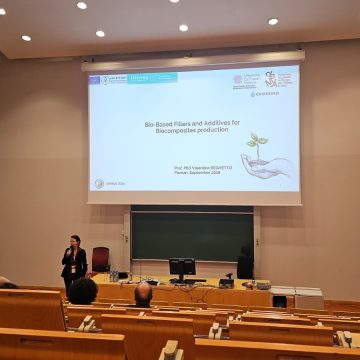
UNIME is continuing research on recyclability and durability of the materials. In this phase, in addition to participating in events and dissemination activities of LIFE RESTART and advancing the project itself (characterizing the first pellets produced by the Zero Factory in Roccavaldina through mechanical-rheological tests), UNIME has also worked on writing and publishing specific scientific papers and has extended the study to different types of bio-polybutylene succinate and spent grains.
Recently, Crossing has also taken part in numerous dissemination activities and collaborated with other partners to advance LIFE RESTART, characterizing the products derived from the Zero Factory in Roccavaldina from a physical and chemical perspective.
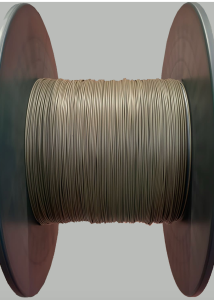 It has also supported Ecosmed, Fondazione Messina, and UNIME in drafting the technical data sheets of the semi-industrial scale biocomposites based on spent grains and the raw materials used in the Zero Factory. It participated in meetings for obtaining food contact certification of the biocomposites (EFSA – European Food Safety Authority).
In particular, spent beer grains were initially analyzed from a chemical-biological perspective, and the results proved satisfactory for continuing the certification process. In the immediate future, tests will also be carried out on the finished product to verify its compatibility with the food sector.
Co-funded by the European Union. Views and opinions expressed are however those of the author(s) only and do not necessarily reflect those of the European Union or CINEA. Neither the European Union nor the granting authority can be held responsible for them.